On the morning after the Senate passed FOSTA we texted each other about whether we should remove our ads from our social media accounts. We weren’t exactly sure what to do and knew that many other people were in the same situation. FOSTA had not yet been signed into law, and sex workers all over the country already had difficult decisions about our livelihoods and safety to make. Mercurial legal and cyber information and advice were flying around Twitter, online forums, text threads, and worker Facebook groups like wildfire.
We decided to host an emergency meeting for Bay Area sex workers that very weekend. We hoped we would gather a few people in Maxine’s small Oakland living room to share information, and figure out the best ways to move forward. Our small meeting quickly turned into 60-plus concerned workers RSVPing for the gathering. Because of the gravity of this situation the event promptly developed into a comprehensive cybersecurity and risk analysis training; an overview of current advertising platform options; and strategic action planning around local sex worker safety, media advocacy, and policy work.
But the most crucial thing that came from our meeting that we were able to come together to support each other. We didn’t all know each other, but so many of us were able to share and somewhat sooth the fear, sadness, and anxiety that FOSTA created. This worker-to-worker support and solidarity didn’t leave a dry eye in the house.
After our first meeting, we knew we realized how much work there was to be done to keep our communities safer, connected, informed, and empowered. We decided to create an organization to centralize the work needed to advocate for the health, safety & livelihoods of sex workers post-FOSTA/SESTA legislation: Bay Area Pros Support (BAPS).
An integral part of BAPS is to recognize the diverse and intersecting identities that make up our larger sex worker communities and to center the needs of sex workers who have been hit the hardest by FOSTA and experience the most criminalization. It is important to our organization leverage the power and privilege in our communities to create support for workers with fewer resources. One of the most critical subcommittees we have is our Outreach Committee, created to reach workers that are not online, and work with them to connect them with support.
The purpose of this article is to share the information and resources that BAPS has gathered thus far—on cybersecurity, general FOSTA/SESTA information, and post-FOSTA-SESTA organizing. Below are detailed notes and action plans for our meetings. One of the biggest lessons we have learned is that having community support through this process has been crucial. We hope that the creation of BAPS will encourage other sex workers who wish to organize in their communities as well.
When reading this guide, please keep in mind that everyone is making decisions that are incredibly hard, and only you can know what’s right for you. We tried to gather as much information to share as possible to empower people to make the best decisions for themselves. There is no one or “right” way to navigate this complicated situation.
After the 2016 election I thought I would die if I didn’t do something now, immediately, something tangible where I walked away knowing that both I and the other person were better off after interacting: them with something concrete—whether it was a sandwich or hot coffee or condoms or whatever—and me feeling like I had made something better for someone. I needed that to keep on going.
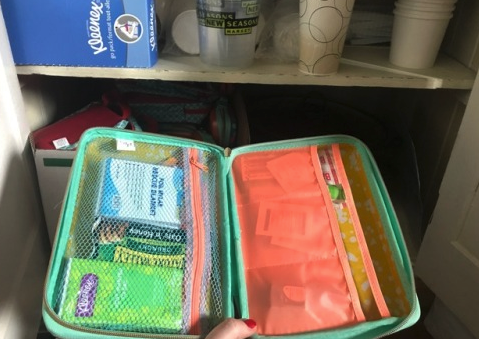
If you’re at that point now, street outreach can be that something. Something solid to focus your energy on, and a tangible human interaction to keep you going. Something that requires planning and focus but something that your whole life doesn’t depend on, unlike making rent, which is a nice change of pace!
How do you start doing street outreach? Good question! Luckily I am here and you can benefit from all the mistakes I made.
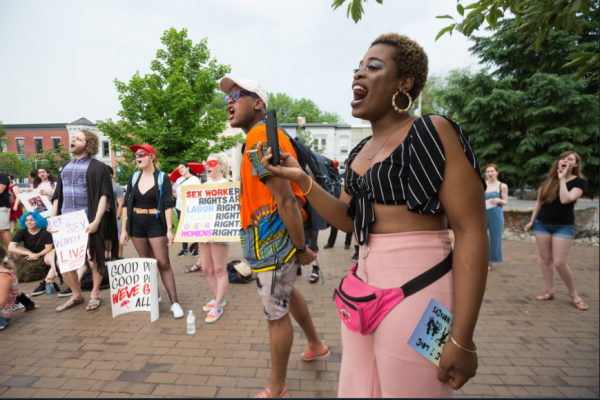
International Whores’ Day at the Eastern Market Metro Station in Washington, D.C. (Photo by Francis Chung via Twitter)
What a week it’s been for sex worker organizing! The first sex worker Lobby Day on June 1st was followed by nationwide sex worker action on International Whores’ Day on June 2nd. Post-SESTA, this annual day of organizing picked up more momentum than ever. Here’s our attempt at curating the coverage of this week’s news for you:
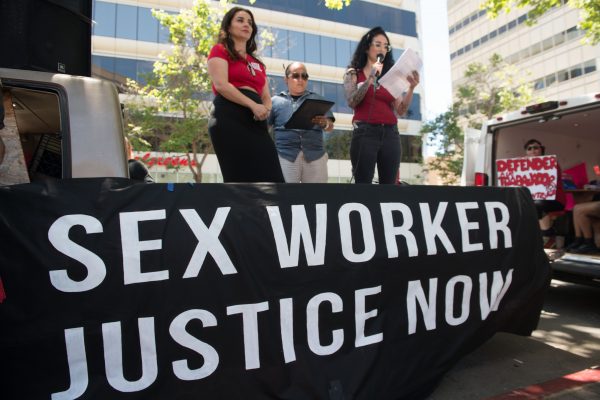
Community organizer and cam and porn worker Anna Moone wrote for Vice’s Motherboard on sex worker Lobby Day in D.C. this Saturday. Organized by SWOP and Survivors Against SESTA, 40 sex workers found a surprisingly welcome reception in Capitol Hill from both staffers for reps who voted for SESTA and for those who voted against it:
I expected these meetings to be an uphill battle of fighting for our humanity, but we all left the meeting feeling surprisingly hopefully about our prospects for the day.
Even more surprisingly, the other two representatives whose staffers we met—Mark Takano (D-CA) and Don Beyer (D-VA)—both voted against SESTA. Instead of having to explain why SESTA is a harmful bill, we were able to spend our meetings strategizing on how to work together better moving forward. In addition to feeling that the law would hurt sex workers, both Takano and Beyer felt that this bill would make it harder to stop sex traffickers, and they both also had concerns that SESTA might expand mandatory minimum sentencing laws. They also gave us advice on what other staffers and representatives would make good allies for us to reach out to and build relationships with. Finally, they told us how important it was that we came to speak with them, because sex workers contacting our representatives about how bills will harm us gives them the information they need to use to justify opposing bills. ”
“I need to earn a living, but I also have to be safe. So I have to make a really hard choice about what to do, whether I’m going to invite this person into my home. … I’m crippled by fear and anxiety. I was homeless when I was younger, and I just never want to go back there,” Jackie said.
Red says that sex workers’ anger highlighted and validated in the media “allows us to be fully formed human beings in the news.”
“And we deserve that,” Red continues, “because we are fully formed human beings that are just working and surviving and supporting ourselves and our families and our friends as best we can.”
The Daily Beast also covered the New York event, noting the diverse set of speakers that addressed the crowd, including trans sex worker leader Ceyenne Doroshow:
Ceyenne Doroshow, the Founder and Director of the advocacy organization GLITS (Gays and Lesbians Living In a Transgender Society) shared, “I’ve buried so many children. I’ve seen so many girls get murdered…losing my sisters, losing my brothers. This is sick.”
As the rally occupied the space surrounding Washington Square Park’s arch, protestors learned that across the river in Brooklyn, one New York woman working to change anti-sex work laws sat in jail. Tiffaney Grissom said that the previous night she was in the Brooklyn neighborhood of Bushwick, and at about 4 a.m. she was arrested and charged with “loitering for the purposes of prostitution.” Grissom, who is Black and trans, is also a plaintiff on a class action suit challenging this law, charging it is unconstitutional and that the New York Police Department enforce it disproportionately against Black and Latinx women.
Sixteen hours later, Grissom was still waiting for her court appearance. When I met her in 2016, she told me she had engaged in sex work sometimes, but most of the time that she was charged with loitering she was just hanging out. “It’s a way to arrest a lot of people for nothing,” said Cynthia H. Conti-Cook, a staff attorney at The Legal Aid Society, who is involved in bringing the class action suit against the loitering law and who Grissom called after her Saturday arrest. “It seemed like an easy arrest,” Grissom told The Appeal just outside the Brooklyn court where she was released just before 9 p.m. on Saturday. “I don’t need to have to prove myself as to why I’m outside, or defend myself for being outside.”
UPDATE: Emily Witt at the New Yorker published an in-depth longread on NYC IWD events and their leadup, starting from The Black Sex Workers Collective’s fundraiser a few days before, moving to Lobby Day, and then to the day itself. Akynos, Mariah Lopez from STARR (Strategic Trans Alliance for Radical Reform), Red Schulte, Ceyenne Doroshow, Yin Q, Lorelei Lee, and other speakers and organizers are quoted at length. There’s a bit too much scandalized attention on what people were wearing, but Witt does goes into more detail on Tiffaney Grissom’s arrest and release, including the fact that another woman was also released from incarceration for a solicitation arrest that evening:
The arraignment took less than five minutes; Kings County refers low-level misdemeanor cases to a special court. The judge offered the defendants two possible dates, June 20th and June 27th—“Before Pride or after Pride,”[Mariah] Lopez said under her breath. (The New York City Gay Pride March and its attendant celebrations are June 24th.) Both defendants chose June 27th.
Their court dates set, and released from their handcuffs, Lopez led the two women out into the lobby. Lopez hugged Tatiana Hall, who was tearing up. “I was so scared,” she said. It was her first time getting arrested. We went outside and they told their stories. They had both been in Bushwick—“very up-and-coming and trendy,” Grissom said. The police arrested Grissom first, around 4 a.m., Hall later. Both said they were simply outside on the street. Hall had been talking to a man—a gay man, she added. Grissom said she was alone. “I’m not waving, I’m not being extra, I’m not throwing myself into cars, I’m not doing anything abstract, I’m just walking by looking pretty,” she said. “So it’s easy to recognize me, but when you see somebody and they’re not giving you a reason to arrest them, you have to try and figure out ways to get them.” Police officers are allowed to use their own discretion to determine a person’s intention to prostitute, criteria that might include the clothes a person is wearing. As Shekera had lamented, “You never had any rights. The Internet just made you have that false hope and you got comfortable and now the rug has been pulled out from underneath you.”
Editor’s note: Inclusion on this list does not indicate that Tits and Sass is endorsing a particular fund.
Newwhoreizons is “a wealth redistribution club by [sex workers] for [sex workers].” $newwhoreizons on cash.me to donate, newwhoreizons on a private Instagram account for information—DM to request to join the club or ask for help.
Lysistrata is a member-led sex worker fundraising collective which originally formed after the Backpage adult ad closures. They maintain a standing emergency fund for marginalized sex workers as well as promoting and signal boosting individual fundraisers and events. You can donate on Paypal, Venmo, squarecash, or directly through their website. They also have a monthly donation option. You can request emergency assistance over email at lysistratamccf@gmail.com.
Note: Both the organizations above have stated that they are currently receiving more requests for help than donations.
The Black Sex Worker Collective is hosting its first community strategy meeting this coming Saturday, April 15th. Non-Black workers may attend as long as they don’t take up space and make sure to allow Black sex workers to speak and lead. You can donate to the collective here, tax-free through their fiscal sponsor Project Prosper.
CUSP in Alaska is raising money for street outreach supplies to help the many Anchorage workers who’ve been driven into street-based work since this SESTA-fueled series of ad platform closures. They’re going to start a needs-assessment program, and if they receive enough money, they will be expanding their efforts into subsidizing workers’ phone bills.
The Third Wave Foundation is starting a cross-class, multiracial, intergenerational giving circle for women, queer, and trans people with experience in the sex trade to raise money for sex worker-led organizations. Third Wave is framing this as a response to silence from the funding community in general to the passage of SESTA. Participation in the first round of the giving circle will be confined to the NYC area and the deadline for application is April 15th. They are specifically encouraging people of color as well as working class and low-income people to apply for these stipended fellowships. The circle will begin with $150K already raised and fundraise from there—it looks like a promising way for low-income and marginalized sex workers to access philanthropic resources.
As you can see, this list is a bit thin so far. Readers, feel free to link any other fundraisers you’re aware of for sex workers hit hard by SESTA in the comments.
Both sex workers’ rights and anti-trafficking organizations have been watching a bill winding its way through Congress for a while. Here at Tits and Sass, we’ve had plentyto say about it. SESTA, the Stop Enabling Sex Trafficking Act, the Senate version of the bill, would have been disastrous enough—it would create a trafficking-related loophole in section 230 of the Communications Decency Act, the law which allows the internet to function by not holding service providers liable for user posting content. In practice, that would outlaw all sex worker advertising sites by opening them up to endless lawsuits, since any of them can be used for trafficking. That would send vulnerable people back into the streets and other dangerous venues and back into the hands of potentially abusive managers. Just think about the economic panic which followed the closures of Craigslist, MyRedBook, TNA, and Backpage’s adult section and multiply it a thousandfold if you want to imagine the impact this could have on the most defenseless members of our community. And as usual, when the sex trade is driven further underground, trafficking victims suffer as everyone around them is criminalized further, and they are further isolated with no one to turn to but their traffickers.
But the version that passed the House by an overwhelming majority last Thursday, FOSTA, the Allow States And Victims To Fight Online Sex Trafficking Act, was even worse. It criminalizes “promoting” and “facilitating” prostitution without defining these terms, placing vital sex worker online harm reduction resources which both voluntary and trafficked sex workers rely on at risk, such as the verification sites and bad call lists we use to avoid violent clients. This blog you’re reading now could fall in the crosshairs of this legislation as well, as could other sites of sex worker community, making it much harder for an already closeted and stigmatized group of marginalized people to forge vital social and political connections with each other. FOSTA also includes damaging new additions such as a retiring Republican congressman’s clause expanding the Mann Act. It is a bill that has morphed into something much broader and more hurtful than its cosponsors originally envisioned, with law enforcement, social services, the ACLU, EFF, the National Organization for Women, AIDS United and even anti-trafficking organizations as well as the Department of Justice opposing it. Yet representatives rushed to embrace it in a show of bipartisan cooperation.
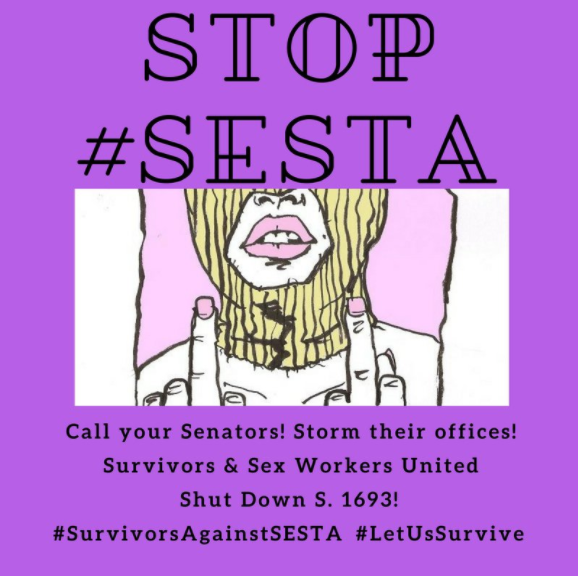
It seems likely that the Senate debate and vote on SESTA will take place on Monday, March 12th. If SESTA passes the Senate, the next step would be reconciliation between FOSTA and SESTA into one no doubt catastrophic law. Today and tomorrow, just as sex workers, free speech organizations, and anti-trafficking organizations mobilized against FOSTA in the House, tweet storms and phone/fax/email jams are planned nationally against this Senate vote on SESTA. We urge all our readers to call their Senators and encourage their social networks to do the same. Scroll down to the bottom of this post for more information and a sample call script.
Longtime sex work and trafficking policy researcher and Reframe Health and Justice partner Kate D’Adamo has led the sex worker and trafficking survivor charge against the House and now the Senate vote. Tits and Sass caught up with her last weekend to ask her what every sex worker should know about FOSTA and SESTA.
How did you mobilize action on the House vote so quickly? Are there any other organizations and individuals whose efforts against FOSTA you’d like to highlight?
This is so far from a solo effort! None of this would have been possible without Red from Support Ho(s)e and the group MASWAN doing some of the most fantastic grassroots organizing work. On the national support and lobbying front, the National Center for Lesbian Rights and the National Center for Transgender Equality have truly shown up.
I think things mobilized so quickly because people have been waiting for a moment to plug in. A lot of times sex worker rights, and movement work in general, can feel intangible; SESTA isn’t and its impacts certainly won’t be. Which also points to how long we have been laying the groundwork. When I talk about what would be impacted, it’s because this movement has been doing harm reduction and anti-violence work for years, finding ways to turn online spaces into community and safety. When folks are connecting online and calling their reps and senators, it’s because we can stand on decades of sex workers demanding liberation and justice.